
Will or Trust? Let’s Make It Clear.

You know you need an estate plan. But what kind?
The first decision is whether to create a Will-based plan or a Trust-based plan.
Both are good estate planning tools. The right choice depends on your property, your priorities, and how you want your estate handled.
Let's walk through the differences.
The Difference in Plain English
Will-based plan
A Will directs who receives your property after your death and who should be responsible for handling your estate.
A Will only becomes effective at death.
Property passing through your Will must go through the probate process in an Arizona court before it can be distributed.
Trust-based plan
A Trust is utilized while you are living. It provides structure for managing Trust assets if you become unable to manage them yourself.
You can transfer property into the Trust and continue to control and use that property during your lifetime.
If the Trust is properly funded, assets held in the Trust can generally pass according to its terms without going through probate. Avoiding probate also keeps your assets and beneficiaries private.
Neither option is automatically “better.” The goal is to choose the one that best fits your circumstances.
Which sounds more like you?
YOU MAY PREFER A WILL PLAN IF:
You want a straightforward estate plan.
Avoiding probate is not one of your highest priorities.
Your estate is relatively uncomplicated.
You are comfortable with your estate being administered through the probate process if probate is required.
You want to keep the initial planning process simpler.
You don't want the additional step of transferring assets into a Trust.
YOU MAY PREFER A TRUST PLAN IF:
Avoiding probate is important to you.
You own a home or other significant assets you want held in a Trust.
You want someone to be able to manage Trust assets for you if you become incapacitated.
You own real estate in more than one state.
You want greater control over when or how beneficiaries receive an inheritance.
You are willing to take the additional steps required to properly fund and maintain a Trust.
Will vs. Trust at a Glance
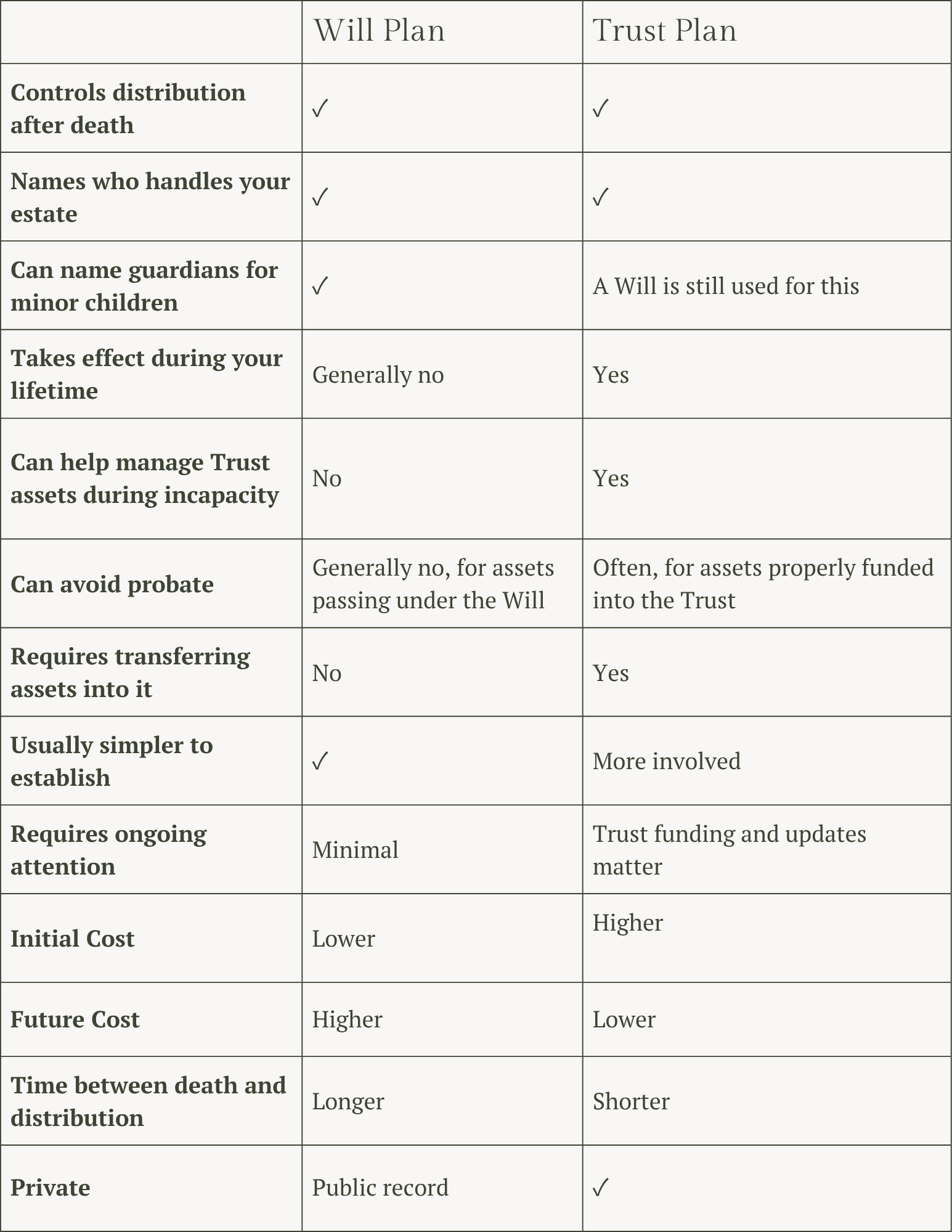
Important: A Trust does not avoid probate merely because it exists. Assets generally need to be properly transferred to or coordinated with the Trust.
Ask Yourself These 5 Questions
-
If avoiding probate is a priority, a properly funded Trust may be worth considering.
Property passing under a Will generally requires opening a probate case in a probate Court.
-
Owning a home does not automatically mean you need a Trust.
But real estate is often one of the reasons people consider a Trust. This is particularly true when avoiding probate is important or when real property is located in more than one state.
-
Both Will and Trust based plans created through Clear Path appoint agents to act for you if you are incapacitated through appropriate powers of attorney.
A Trust adds another layer: your successor trustee can generally step in to manage property already held in the Trust according to the terms of the Trust.
-
If you simply want property distributed outright after your death, either type of plan works.
If you want property held in trust for beneficiaries and distributed at different specified times, a Trust offers more flexibility. This may be desirable if a beneficiary is young, or you don't want a large inheritance distributed all at once.
-
Creating a Trust is only the beginning.
To obtain many of its benefits, appropriate property must be transferred into the Trust. New assets may also need to be transferred into the Trust when purchased after trust formation.
If you don't want that additional responsibility, a Will-based plan may be the better fit.
You Don't Need a Trust Just Because You Own a Home.
Although Trusts are valuable estate planning tools, not everyone needs one.
A good estate plan isn't the plan with the most documents. It's the plan that fits your circumstances and accomplishes what matters to you.
For some Arizona families, a Will-based plan is completely appropriate.
For others, the additional planning and administration involved with a Trust is worth it because of the benefits it can provide.
Clear Path is designed to help you make that decision thoughtfully, not simply sell you the more expensive option.
Still Not Sure?
Start with the Will Plan if...
Your assets are limited, probate avoidance isn't a major concern, or you want a simpler and less expensive option.
Take a closer look at the Trust Plan if...
Avoiding probate, or controlling future distributions is particularly important to you, or you own property in multiple states.
Can’t Decide?
You don't need to guess.
Legal guidance is available if your situation requires a more individualized analysis.
You Don't Need to Figure out Your Entire Estate Plan Before You Begin.
You just need to get started.
Your path. Your plan. Your peace of mind.